
Continual learning: the missing half of AI
Continual learning (also called continuous learning or lifelong learning) is the ability of an AI system to keep learning during live operation: taking in new information from its environment, updating its internal understanding and adapting its behavior as conditions change, without being taken offline for retraining. It is the counterpart to training. Training builds one half of intelligence before deployment; continual learning is the half that continues afterwards.
Almost every AI system in production today follows the same lifecycle. It is trained on historical data, deployed, and then frozen until the next scheduled update. Between those updates, the world keeps moving while the system's understanding of it stands still. This page explains what continual learning is, why the gap it closes matters economically, what evidence we have that it works, and how we build it at Wakeline. It also collects our writing on the topic in one place.
What continual learning is, and what it is not
The term gets stretched to cover almost anything that changes after deployment, so precision matters. Several common techniques are frequently confused with continual learning and solve a different problem.
Scheduled retraining
The system is retrained on an updated dataset at fixed intervals and redeployed. Between cycles it remains static, and every cycle costs compute, engineering time and validation effort. The lag between reality and the system's knowledge never closes; it just resets.
Fine-tuning
A pretrained system is adapted once to a domain or task. This is still training: it happens offline, on a curated dataset, before the system meets live data. After fine-tuning, the system is exactly as frozen as before.
Retrieval augmentation
The system is given access to fresh documents at inference time. Its answers can reference new information, yet nothing inside the system has learned anything. Remove the retrieved context and the new knowledge is gone.
Continual learning
The system itself changes in response to what it encounters in operation. New observations update its internal representations permanently, the way experience updates a biological learner. Learning and deployment stop being separate phases and become one continuous process.
| Approach | When learning happens | What changes inside the system | Effort per update | Response to drift |
|---|---|---|---|---|
| Continual learning | During live operation, permanently | Internal representations update and accumulate | None beyond operation itself | Follows drift as it happens, including regime shifts |
| Online learning | During live operation | Parameters update incrementally, typically for a single task | Low, though stability safeguards are needed | Tracks gradual drift; new updates can overwrite older knowledge |
| Scheduled retraining | Offline, at fixed intervals | A new snapshot replaces the old one entirely | High: data pipelines, validation, redeployment | Lags behind until the next cycle completes |
| Fine-tuning | Offline, once per adaptation | Weights adjust to a domain, then freeze again | Medium: curated data and validation per round | None after deployment |
| Retrieval augmentation | Never; fresh context is looked up at answer time | Nothing inside the system itself | Low: index maintenance | Can surface new facts while its understanding stays fixed |
For the deeper version of this distinction, read our essay on what continual learning actually means, and what it does not.
Why it matters: the world does not hold still
The limitation of static AI is structural, and it shows up wherever the operating environment changes faster than the retraining cycle. Energy markets reprice on weather, policy and infrastructure events within hours. Production lines drift as tools wear and materials vary. Patient populations, sensor fleets and supply chains all evolve continuously. In each case, a system trained on yesterday's data carries yesterday's assumptions, and the cost of that lag compounds silently until it surfaces as a wrong decision.
The industry's standard answer is to retrain more often, which treats the symptom at growing expense. Each cycle demands data pipelines, compute budgets, validation runs and redeployment risk, and the moment it finishes, the clock starts again. Scale makes the underlying issue worse rather than better: a larger system trained the same way is a larger snapshot of the past.
Continual learning attacks the structure instead of the symptom. A system that updates its understanding during operation stays aligned with its environment by construction. There is no gap to close because no gap is allowed to open.
The evidence
Claims about adaptivity are easy to make and hard to verify, so we benchmark ours in public. Our most extensive evaluation to date measures the forecasting function of our architecture on the German-Luxembourg day-ahead electricity market, one of the most regime-unstable forecasting environments available, across 2,097 trading days that include the COVID period and the 2022 energy crisis.
≈14% higher cumulative trading P&L than TabPFN
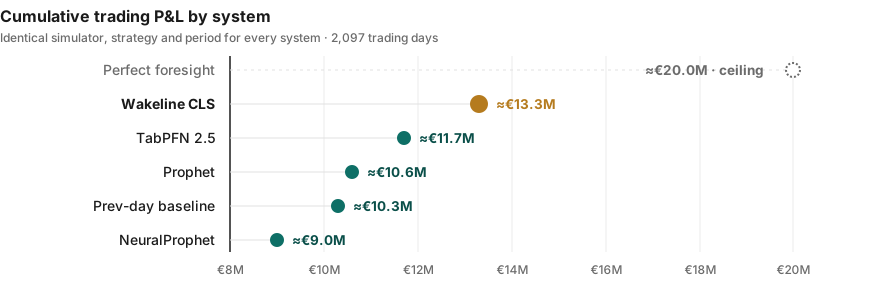
Our continuously learning architecture entered the backtest untrained, learned fully online, and outperformed a pretrained, state-of-the-art foundation architecture for tabular prediction on the economically decisive metric, under a benchmark setup deliberately tilted in the benchmark's favor. It also outperformed Prophet, NeuralProphet and a naive persistence baseline. The advantage concentrated precisely where continual learning predicts it should: in periods of extreme regime change.
Read the full benchmark report, including methodology, transparency notes and limitations.
These results are internal and documented with their full setup and caveats. They are one data point in favor of a broader claim we intend to keep testing publicly: that fast-adapting systems hold a structural advantage over fixed architectures whenever the world refuses to be stationary.
How we build it
The Continuous Learning System (CLS) is our AI architecture built around exactly this capability, inspired by biological learning principles: it enters a deployment untrained and adapts online from live data throughout operation. Learning and application are interwoven instead of running as separate phases, so there are no retraining cycles and no redeployment gaps.
"Training builds a snapshot of the world. Everything interesting happens after that snapshot is taken. We build the half of intelligence that keeps up."
Functionally, the architecture spans three concerns. A continuous perception layer forms expectations about the environment from live signals; this is the layer our energy benchmark evaluates. Above it, the architecture maintains state over time, so that what was learned persists and accumulates. And it allocates its own internal resources toward what the environment currently makes relevant. The CLS runs independently of proprietary foundation systems and hyperscale cloud infrastructure, which keeps deployments technologically sovereign.
We deliberately describe the architecture at this behavioral level. The implementation is the subject of ongoing patent proceedings, and we walk qualified partners through the deeper technical material in direct conversations.
Streaming intelligence: learning the way nature does
The world does not present itself as a dataset. It arrives as many parallel streams that never pause and never wait to be labeled. An energy market is streams of prices, grid load, wind, solar and cross-border flows, each on its own rhythm. A production line is streams of sensor readings and machine states. Biology solved this problem long before machine learning existed: every organism builds its understanding of the world from parallel sensory streams, continuously and without anyone providing training examples.
At its core, the CLS is built for exactly this reality. It is a streaming architecture: it consumes multiple parallel data streams natively and forms its understanding directly from them, without supervision and without any pretraining. Higher-level structure emerges from the streams themselves. The system discovers recurring patterns and relationships across its inputs and composes them into higher-level representations of the objects and situations in its environment, the way perception assembles a scene from raw signals. In our energy application this is concrete: 83 parallel streams of load, generation and cross-border flows, arriving every 15 minutes, become a live understanding of the market from which price expectations form.
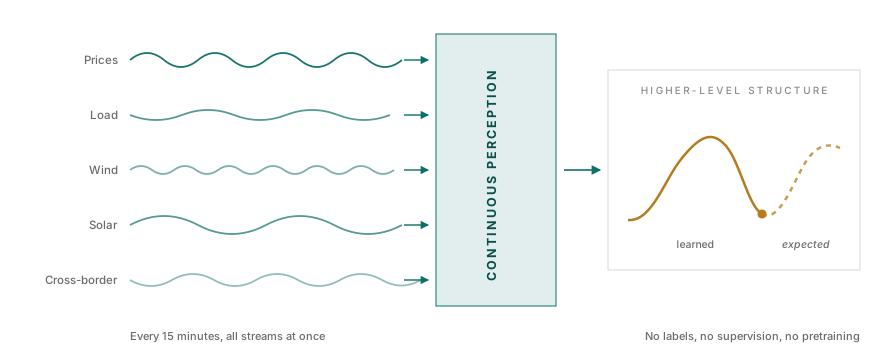
This is why the CLS can enter a deployment untrained and still become competent in it: the streams of the environment are its curriculum. It is also why the architecture transfers across domains. The energy market, the factory floor and the research lab differ in every surface detail, yet each one is, structurally, a set of interacting streams from which meaningful objects can be learned.
Most machine learning inverts this. It requires the streams to be stopped, sampled, aligned into a table, labeled and only then learned from, which is precisely why those systems freeze the moment the sampling ends. Building for streams first is what makes learning in operation possible at all.
Where it applies
There are two ways to work with this capability today.
Market Edge is the first concrete product built on top of the CLS: adaptive day-ahead price forecasts for European battery storage operators, running live in a domain where regime shifts are the norm and forecast quality converts directly into revenue. It perceives the German-Luxembourg bidding zone through 83 live input streams at 15-minute resolution, covering load, generation by fuel type and cross-border flows across all four TSO control areas, and turns that perception into deliverables ranging from rolling live forecasts to an exchange-ready day-ahead bundle. It is the application behind the benchmark results above, and it exists so the architecture can be experienced rather than merely read about. At the same time, it exercises a single function of a single layer. What Market Edge shows is real; what the architecture underneath can carry is considerably larger.
The larger opportunity is steering. Modern infrastructure is full of complex networks that never stop changing: power grids balancing volatile generation, factories where hundreds of machines and material flows interact, logistics chains rerouting around disruptions daily. These systems share one structure. Many parts influence each other through live signals, and the conditions governing them shift faster than any static model of them can be rebuilt. Wherever such a network needs to be understood and optimized in operation, we are the partner to talk to. For software companies that already build the planning and optimization platforms steering these networks, the architecture is available as a learning layer: it sits alongside proven decision engines and improves the intelligence feeding them, while the platform's decision logic and implementation model remain intact. We validate through shadow deployments against agreed success metrics before anything is embedded.
The same architectural property extends to research settings such as biosignal analysis, where each subject and session differs from the last. The common thread is always the same question: does your environment change faster than your retraining cycle? Wherever the answer is yes, a static system is structurally behind.
Risks, limitations and governance
Continual learning solves a structural problem and introduces obligations of its own. We consider it dishonest to present the first without the second.
The classic technical risk is catastrophic forgetting: new learning overwriting older knowledge. It is the central failure mode when continuous updating is retrofitted onto architectures designed for one-time training, and it is one instance of a deeper trade-off the research literature calls the stability-plasticity dilemma: a system must be plastic enough to absorb new information and stable enough to preserve what it already knows. We treat this as an architectural question rather than a training trick; our memory structures are designed to grow and reorganize instead of overwriting, and our multi-year benchmark shows stable relative performance without late-horizon degradation. That evidence is specific to the environments we have tested, and we present it as such.
The governance question is just as real: a system that changes in operation must be observable in operation. Our deployments track forecast quality and behavioral metrics continuously, so drift in the system is as visible as drift in the world, and every change in outcome can be traced to a point in time. Before anything is embedded in a partner's product, we validate through shadow deployments against success metrics agreed in advance, which gives both sides an auditable record of how the system behaved before it was trusted.
Finally, the field itself is young, and anyone claiming continual learning is a solved problem should be read with suspicion, ourselves included. What we claim is narrower and testable: that in non-stationary environments, a system designed for continuous updating holds a structural advantage over systems that freeze at deployment, and that this advantage is measurable in economic terms. The limitations of our own published evidence are documented alongside the results in the benchmark report.
Where this work sits in the field
Continual learning is an active research field with a lineage reaching back decades. The stability-plasticity dilemma was articulated in the neuroscience-inspired literature of the 1980s, and catastrophic forgetting was documented in neural networks by the late 1980s. Modern research addresses the problem along several lines: replay methods that rehearse past experience, regularization methods such as elastic weight consolidation that protect important parameters, and architectural methods that give systems structures which grow and reorganize. Our work belongs to the architectural line, informed by biological learning principles, and is distinctive in treating continual learning as the design premise of the whole system rather than a capability added to a trained one.
- Grossberg, S. (1980). How does a brain build a cognitive code? Psychological Review.
- McCloskey, M. and Cohen, N. J. (1989). Catastrophic interference in connectionist networks. Psychology of Learning and Motivation.
- French, R. M. (1999). Catastrophic forgetting in connectionist networks. Trends in Cognitive Sciences.
- Kirkpatrick, J. et al. (2017). Overcoming catastrophic forgetting in neural networks. PNAS.
- Parisi, G. I. et al. (2019). Continual lifelong learning with neural networks: a review. Neural Networks.
- Hollmann, N. et al. (2025). Accurate predictions on small data with a tabular foundation model. Nature. (The TabPFN architecture referenced in our benchmark.)
Go deeper: our writing on continual learning
We have been writing about this problem from first principles. The essays below are grouped by the question they answer.
Foundations
- What Continual Learning Actually Means - and What It Doesn’t
- Why Intelligence Cannot Rely Only on What It Learned Before
- When the World Moves: Concept Drift, Data Drift, and Label Drift
Architecture and memory
- Why Weights Are the Wrong Place to Store Experience
- Stateful vs. Stateless Systems - Why the Distinction Matters for Artificial Intelligence
- Learning From the World Versus Learning About the World
- Intelligence as a Temporal Process
In practice
Glossary
- Continual learning (continuous learning, lifelong learning)
- The ability of an AI system to keep learning during live operation: updating its internal understanding and adapting its behavior as conditions change, without being taken offline for retraining.
- Online learning
- Incremental parameter updates during operation, usually for a single task and without dedicated mechanisms for preserving older knowledge. A component of continual learning rather than a synonym for it.
- Scheduled retraining
- Rebuilding a system offline on updated data at fixed intervals and redeploying it. The system remains static between cycles.
- Concept drift
- A change in the relationship between a system's inputs and the outcomes it predicts, so that patterns learned earlier stop holding.
- Model drift
- The degradation of a deployed machine learning system's performance over time as its environment moves away from the data it was trained on.
- Catastrophic forgetting
- The overwriting of previously learned knowledge when a neural system learns something new; the central failure mode of naive continuous updating.
- Stability-plasticity dilemma
- The trade-off every learning system faces between being plastic enough to absorb new information and stable enough to preserve what it already knows.
- Streaming AI
- Systems that learn directly from live, parallel data streams instead of from static, pre-assembled datasets, discovering higher-level structure in the streams during operation.
Frequently asked questions
What is streaming AI?
Streaming AI describes systems that learn directly from live, parallel data streams instead of from static, pre-assembled datasets. Rather than stopping the world to sample, align and label it, a streaming architecture consumes the streams as they arrive and discovers higher-level structure in them during operation. Our CLS is a streaming architecture at its core, which is what enables it to enter deployments untrained and learn continuously.
Is there a difference between continual learning and continuous learning?
The terms are used interchangeably in practice, alongside lifelong learning and online learning. The research literature slightly prefers continual learning; industry writing slightly prefers continuous learning. All of them describe the same capability: a system that keeps learning during live operation. We use both.
How is continual learning different from fine-tuning?
Fine-tuning is a one-time, offline adaptation performed before or between deployments; the system is frozen afterwards. Continual learning happens during operation itself: the system updates permanently from the live data it encounters, without an offline phase and without redeployment.
Doesn't continual learning cause catastrophic forgetting?
Catastrophic forgetting, where new learning overwrites old knowledge, is the central failure mode when continual learning is retrofitted onto architectures that were designed for one-time training. It is a strong reason to treat continual learning as an architectural question rather than a training trick. Our approach is designed for continuous updating from the ground up, with memory structures that can grow and reorganize instead of overwriting, and our multi-year benchmarks show stable performance without late-horizon degradation.
Is a continuously learning system safe to operate?
A system that changes in operation must be observable in operation, and we consider the two inseparable. Our deployments track forecast quality and behavioral metrics continuously, so drift in the system is as visible as drift in the world. Notably, the benchmark evidence shows the opposite of instability: relative performance stays stable across years of operation, while static systems are the ones that quietly fall out of alignment between retraining cycles.
Do large language models learn continually?
No. Large language systems are trained in discrete, expensive cycles and are static between releases. Retrieval and long context windows let them reference fresh information at inference time, yet the underlying system does not change from what it encounters. Continual learning in the strict sense requires the system itself to update during operation.
Where can I see evidence that this works?
Our benchmark report documents a 2,097-day evaluation on the German-Luxembourg day-ahead electricity market, where our continuously learning architecture outperformed TabPFN, Prophet, NeuralProphet and a naive baseline on realized trading P&L, with the full methodology, transparency notes and limitations published alongside the results.
Talk to us
If your environment changes faster than your retraining cycle, we would like to hear about it. We share the deeper technical material, including our full benchmark reports, in direct conversations. Get in touch.