Abstract
Our previous report described a continuous learning system reconstructing a capital-gains tax schedule from the consequences of its own decisions, having been given no description of the domain. That rule never moved. Keeping a learned rule current without being told the environment has changed is the requirement an unattended deployment actually faces, and it is what this report tests. Here the tax rate follows a schedule the system is never shown, changing five times within a single 26-year run, with no reset, no notification and no marker in the data. At each of the 25 boundaries we measure how long the learned values take to register the change, how long to reach the new rule, how far they then sit from it, and what the system reports where no rule exists. The same schedule runs through two Q-learning configurations, one whose step size decays with experience and one whose step size stays constant.
Our system registered every change and, at the primary readout, re-acquired every new rule, at medians of 70 and 294 trading days, and read approximately zero where the rule was absent. The two baselines failed in the two ways the literature says they trade off: the decaying variant missed three changes and left eight acquisitions incomplete, the constant variant missed fourteen and reported a signal seven times the true one where none existed. A refutation condition frozen before the runs was not met on any clause. Of twelve registered items, eleven predictions and one attribution rule, six predictions failed, including our own account of why restricted feedback should be harder. Claims are made for the full-observability setting; results are internal and not independently replicated.
1. Introduction
A system that learns a rule once has shown it can recognize structure. A system that keeps a learned rule current, without being told the world has changed, has shown something an operator can act on: it can be left running.
The failure modes here are old and they come in a pair. A learner that averages over its whole history holds on to a rule after the rule has gone. A learner that trusts only recent experience never accumulates a rule at all. Between them sits a choice about how much of the past to keep, and for the standard tabular methods that choice is made in advance by whoever sets the step size. The literature calls the underlying tension the stability-plasticity dilemma.
Our architecture does not expose that choice as a parameter. Whether that is an advantage or an untested assumption is an empirical question, and this report answers it for one rule in one environment.
2. Experimental setup
The environment, the interface, the observation and the two readout levels are unchanged from the previous report (Learning a Hidden Cost Structure from Outcomes Alone), which should be read first. The system sees a stream of numbers per register and three buttons, is told nothing about the domain, and receives the resulting change in value. The tax exists only in the environment's accounting and in the outcome record, never in anything the system reads when deciding.
The schedule. One continuous run of six segments of about four and a half simulated years each, at 0%, 25%, 10%, 40%, 25% and 0%. Nothing marks a boundary. The system is not reset, not notified, and receives no signal that anything has changed except that selling now costs something different. The 25% rate appears twice, separated by two other regimes, so that a returning rule can be measured against its own first acquisition.
Controls. Each learner also ran the reversed schedule, so that any effect belonging to a stretch of market history rather than to a rule change would move with the calendar rather than with the schedule. And each learner ran four constant-rate reference runs, one per rate, because "how long did it take to re-acquire the rule" is only meaningful against the level that learner itself settles at for that rate over that stretch of history. Every comparison is seed-matched: three seeds forward and two reversed per learner.
What is measured. Four quantities, on frozen definitions applied identically to every learner, at each of the 25 rate-change boundaries:
- Detection. Steps from a boundary until the learned values move decisively toward the new rule, judged against their variation beforehand.
- Re-acquisition. Steps until they reach the new rule's reference level and hold it. An acquisition that has not completed by the end of its segment is recorded as a failure, not as a slow success.
- Interference. How much of the old rule persists in the readout during the transition.
- The null reading. What the learner reports in the segments where the rate is 0% and the correct answer is nothing.
Every quantity is computed at two readout levels, as in the previous report. Figures quoted in the text are the primary readout unless stated; the secondary readout is stricter and orders every comparison below the same way, with the differences noted where they matter.
A word on detection, because the term claims more than we measured. This is a property of our measurement, not of the system's internals. An external probe, aligned to a boundary we know about and the learner is never told about, registers when the learned values begin to move. Neither learner contains a change detector. Every detection figure is an upper bound at the resolution we sampled.
Pre-registration. As before, every expectation, threshold and measurement definition was frozen in a manifest before any measured run and graded afterwards on its literal wording. This time the manifest also fixed a refutation condition for the report's central claim, and a mapping from each possible outcome to what the published claims would then be. Both are quoted where they apply below.
3. Results and observations
3.1 Tracking an unannounced change
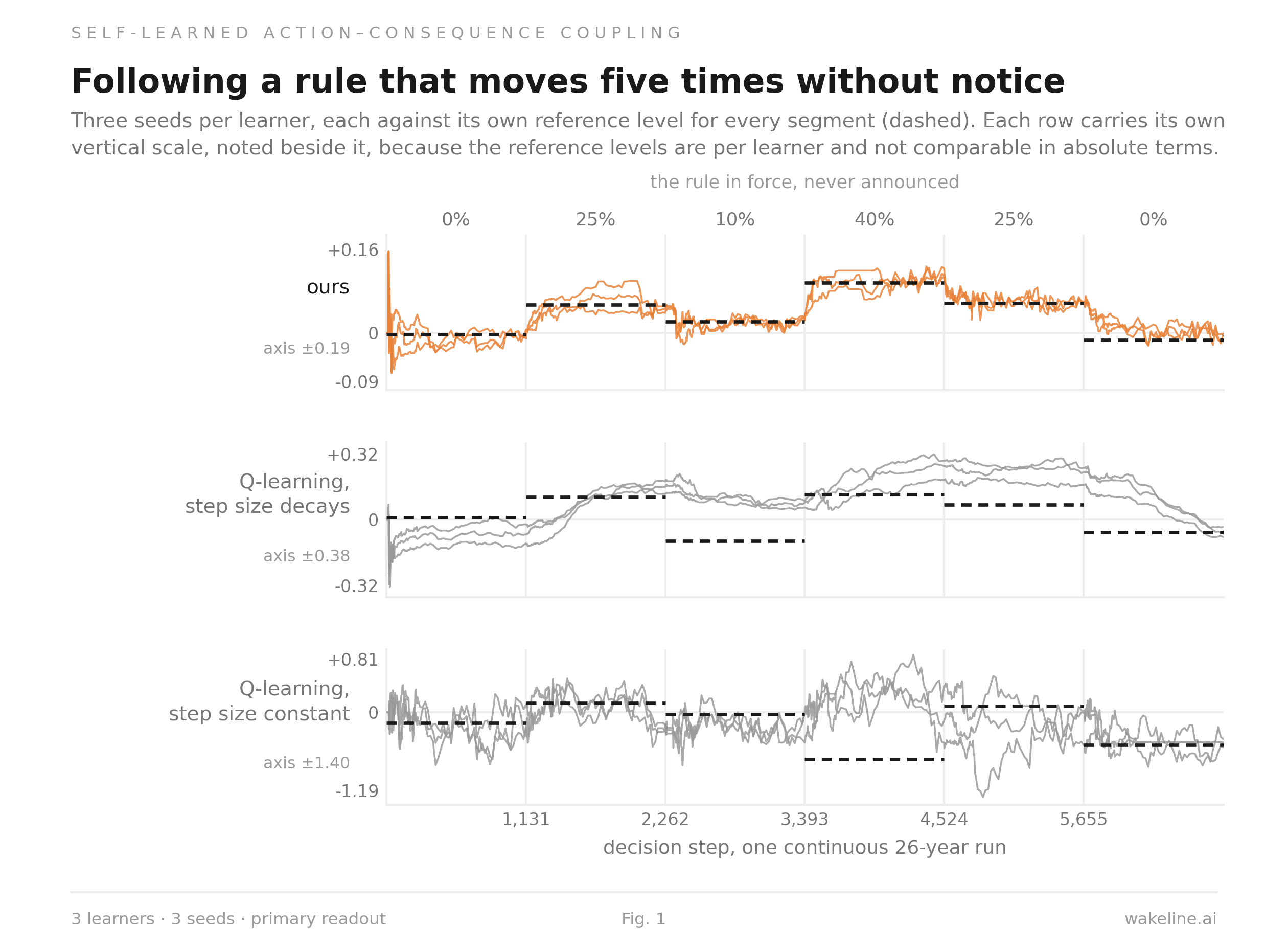
Figure 1 shows the readout of all three learners through the schedule. Across the 25 boundaries, our system registered every change and re-acquired every new rule. Median detection was 70 trading days, roughly three months; median re-acquisition 294 days. No acquisition was left incomplete at the end of its segment. In the two segments where the rule was absent, the readout sat at about 7% of the reference signal, with no tendency to drift.
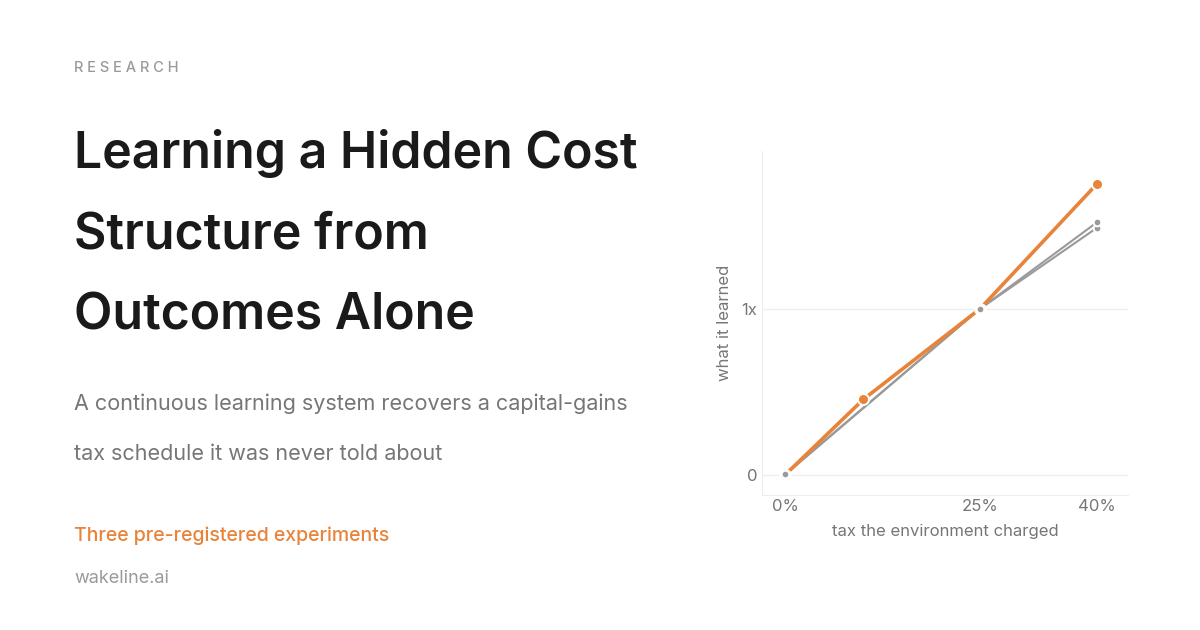
The reference levels the system settles at under constant rates line up in proportion to the rate charged, at 0%, 10%, 25% and 40%. That is the previous report's dose-response, measured again on the far side of four unannounced regime changes: whatever the environment charges, that is what the readout re-derives.
The reversed schedule reproduces all of it. Slow cells exist, and they follow the calendar rather than the direction or size of the rule change: two stretches of market history slow every learner in this study, in both orderings, whichever change happens to land there. Why those windows are difficult is not established here, and Section 4 says what we can and cannot attribute.
3.2 Comparison with two baseline configurations
The comparison carried a refutation condition, frozen before the runs: if the Q-learning baseline matched our system on re-acquisition speed, on completed acquisitions and on interference, at both readout levels, the claim that our architecture handles rule change better than a standard method would be recorded as refuted and this report would say so. No clause was met, at either readout, in either study.
What the two baseline configurations did instead was fail in the two opposite ways the choice between them is supposed to trade off. Table 1 gives the counts, and Figure 2 shows them alongside what each learner reports where no rule exists. All three learners in this subsection ran with full observability of unmade actions; the restriction discussed in 3.3 was applied to our system only.
| detected, of 25 | re-acquired, of 25 | median re-acquisition | median error against own reference | null reading, relative to true signal | |
|---|---|---|---|---|---|
| ours | 25 | 25 | 294 days | 0.018 | ~0.07x |
| Q-learning, decaying step size | 22 | 17 | 399 days | 0.153 | 0.94x |
| Q-learning, constant step size | 11 | 12 | see note | 0.244 | 7.0x |
Table 1. Detection and re-acquisition counts across the 25 rule changes, the typical distance from each learner's own reference level, and the reading each learner reports where no rule exists. Primary readout. At the secondary readout one of our 25 acquisitions is incomplete, the decaying baseline fares worse than shown here, and the constant one no better. The constant-step variant's re-acquisition median is computed over the minority of boundaries where it acquired anything, so it is not comparable to the others and we do not print it.
The error column is the one quantity in the table that is directly comparable between learners, since detection and re-acquisition are each scored against a different target. It is the median, over all measurement points, of the absolute difference between the readout and that learner's own reference level for the segment in force, in readout units and not normalized. Our system sits 8.6 and 13.8 times closer to its own target than the two baselines do to theirs, and the gap widens at the tail: at the ninetieth percentile the three figures are 0.049, 0.270 and 0.790.
Two properties of that column should be stated rather than left implicit. It was not part of the frozen measurement set, so it is reported as descriptive and is not graded in the appendix. And because it runs over every measurement point, including the stretches after a change when no learner has adapted yet, it mixes settled accuracy with time spent adapting, charging a slow learner twice. We did not normalize it by each learner's own variability: a learner with large variability is then flattered by its own noise, which is a defect already documented for the interference metric.
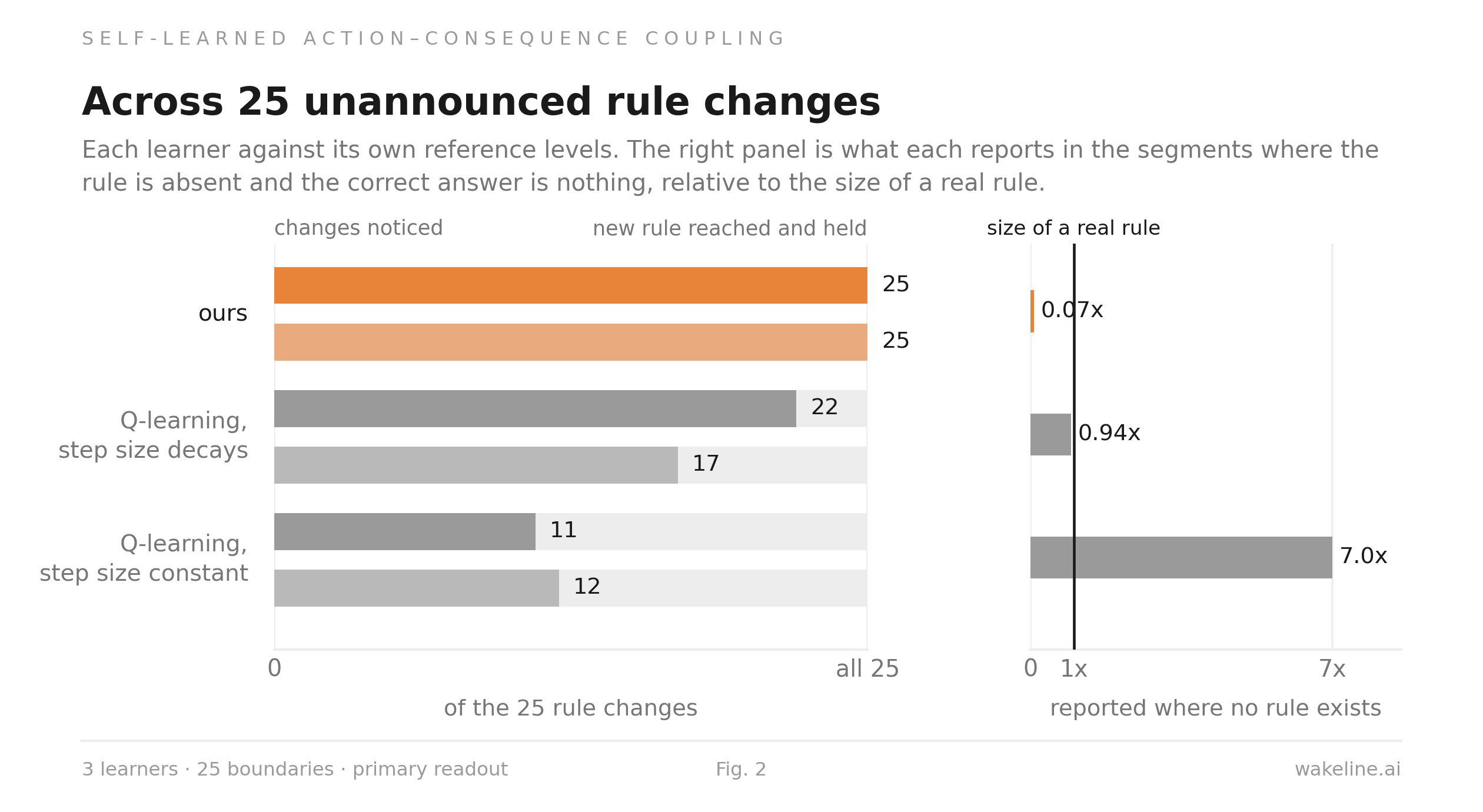
The variant that keeps its history cannot let go of it. It missed three changes, left eight acquisitions incomplete, and arrived late to the rest. At the null rule it reports a persistent signal about the size of the true 25% signal. It also has a problem that only appears when the target itself is measured: its reference level is not a level. Two runs of the identical configuration at the identical seed settled 3.7 times apart. Re-acquisition presupposes something stable to return to.
The variant that keeps only recent experience never accumulates anything to keep. It missed 14 of 25 changes, its own readout noise being some ten times the others' and large enough to swallow the signal it exists to react to. It read the 10% regime with the wrong sign in every run. In the segments with no rule at all it reported a signal seven times the size of the true one at 25%. Its step size won its tuning search on short runs, where reacting quickly is indistinguishable from learning quickly.
One scope fence, registered before the runs and kept: this result concerns the tuned constant-step configuration, not forgetting learners as a class. A smaller constant step would fail more gracefully. Measuring it is a registered follow-up, not an amendment to this one.
3.3 Restricted feedback
The previous report answered a reader who observed that our environment shows the system what every button would have produced, while most environments show only the button pressed. Under that restriction, the fixed rule was recovered at parity.
This study repeated the restriction with the rule moving, and repeated it across the whole protocol: the same five schedule runs, three seeds forward and two reversed, with the restricted system's own constant-rate reference levels measured fresh at every rate. What follows is therefore the full measurement set under both feedback regimes rather than a spot check of one of them. The restriction was applied to our system only. A restricted baseline arm was registered in advance but was contingent on available compute and did not run, so nothing here bears on how a standard method copes without observability under a moving rule.
We predicted the restriction would break our system. The account was specific. Rate increases would be noticed quickly, because in a low-rate regime the system sells often and the new cost surfaces immediately. Rate decreases would be unlearned slowly or never, because the belief that selling is expensive suppresses the very sales that would correct it. We registered a threshold of sixteenfold for the effect, and a test to tell a failure caused by missing evidence from a failure caused by not using it.
The asymmetry does not exist. Re-acquisition after a decrease came out at parity with re-acquisition after an increase, a ratio of 1.00 against the registered 16. It is also at parity with the fully informed system's own performance at decreases, and on the raw numbers slightly better, 430 days against 693. The starvation account fails on its own registered test: every failed cell carried between 144 and 295 executed sales in its segment, far above the threshold at which we had agreed to call evidence insufficient, and every one was therefore graded as inability rather than starvation. The cells that failed sit at the same two calendar windows that slow every learner in the study.
What the restriction does cost is time to notice. Median detection rises from 70 days to between 135 and 240 at the primary readout, slower still at the secondary, and one to two of thirteen decrease boundaries were missed at our sampling resolution. Late, but not blind: no increase boundary was missed anywhere.
The frozen outcome mapping keys on the detection prediction rather than on re-acquisition. Because that prediction failed, the mapping assigns the third of its three outcomes, in its own words, that taken-action-only tracking of moving rules is not established, and the claims of this report are scoped to full observability throughout. We adopt that scoping as written.
We also record what the letter of it does not capture, because the measured shape is not the one the mapping's wording anticipates. Relearning under restricted feedback is at parity in both directions across the full protocol; the deficit is in latency alone. A reader who takes the scoping to mean the restricted case barely worked would be reading the label rather than the measurement. The scoping stands because it was frozen before the runs, not because it describes what we found.
4. Limitations
Scope of the claims. The results of 3.1 and 3.2 are for the full-observability setting. The restricted-feedback runs of 3.3 cover our system alone, are reported as data, and no claim of this report rests on them. A restricted baseline arm was registered and not run, so the comparison between architectures under restricted feedback is untested.
Detection. Every detection figure is an upper bound at our external sampling resolution, and none of them is evidence that anything inside the system marks a change as a change.
The slow calendar windows. Two stretches of market history slow acquisition for every learner, in both schedule orderings. That this is a property of those windows rather than of any rule change is established by the reversal. Why those windows are difficult is not. The leading account, that a rule change hands the learner a portfolio assembled under the previous rule, is an inference by elimination and is not demonstrated here.
Relearning a familiar rule. The intuitive expectation, and the one the memory framing would license, is that the second visit to the 25% rate would be quicker than the first. What we registered, against our own interest, was that neither learner would show savings above 20%. That is confirmed for our system, in the least flattering way: its second visit was slower, in all five of its runs. For the baseline the prediction could not be graded, since its second visit never completed in four runs of five. The second visit falls in one of the two slow windows at both schedule orderings, so the comparison is confounded and we do not claim an effect in either direction. What we can say is that this study provides no support for the idea that our architecture relearns familiar rules faster, and the framing that would predict such savings is unsupported at these timescales.
The baselines. Every caveat from the previous report's baseline section carries: a small single-replication tuning search, exploration mechanisms that differ by necessity, and a prior that only our system uses. One is new and runs the other way: one baseline's own reference levels are unstable between identical runs, which bounds how precisely any statement about its re-acquisition can be made.
One rule shape. The rule moves in level, not in shape. Thresholds, progressive schedules and interacting frictions are untested.
Replication. All results are internal. None has been independently replicated. The measurement harness built for this study treats the rule as an interface and the schedule as data, so a different rule requires one implementation and a schedule file, with the metrics and grading untouched. We intend to put that in outside hands.
5. Conclusions
Under a rule that changes without announcement, the system registered every change, re-acquired every new rule, kept limited residue of the old one, and reported approximately nothing when there was nothing to report. It did this on one fixed configuration, while the two standard ways of tuning for this problem each demonstrated the failure the other exists to avoid.
The claim is narrower than the one we set out to make. Nothing here shows a familiar rule being relearned faster, and the framing that would predict it is recorded as unsupported. Nor does anything here establish tracking under restricted feedback, though what we measured of it refuted our own account of why it should be difficult. What is established is that keeping a learned rule current, in this environment, did not require choosing in advance how much of the past to keep.
All results were produced internally by Wakeline GmbH and have not been independently verified. Figures are approximate and rounded. This report describes a research system evaluated on historical market data in a simulated environment. It does not describe a live trading system, and no capital was deployed. Simulated results are hypothetical, carry inherent limitations, and are not indicative of any future outcome. Nothing in this report is investment advice, an investment recommendation, an investment strategy recommendation, or a financial analysis, and nothing here constitutes an offer or invitation to buy, sell or subscribe to any financial instrument. No statement is a claim about trading performance, and no performance figures are published. Wakeline GmbH does not provide investment advice, investment brokerage, portfolio management or any other financial service requiring authorisation, and is not supervised by BaFin in any such capacity.
Appendix. Pre-registered predictions, graded
| # | Expectation as written | Verdict |
|---|---|---|
| 1 | The baseline detects changes faster at a majority of boundaries; ours detects at every boundary | Failed on the first clause, against us: ours was faster, 70 days against 132, and the baseline missed three changes. Confirmed on the second, 25 of 25 at both readouts |
| 2 | The baseline re-acquires faster but fails to re-acquire more often | Failed as a compound: it failed more often, eight against zero, and was also slower |
| 3 | Neither learner shows relearning savings above 20% on the second visit to a rate, registered against our own interest | Confirmed for our system, in the least flattering way. Not merely no savings: all five of its second visits were slower, and the registered consequence clause applies as written, so the memory framing is unsupported at these timescales. Ungradeable for the baseline, whose second visit never completed in four of five runs; the one gradeable run showed savings above the threshold and is noted, not graded. The calendar confound is stated in Section 4 |
| 4 | Interference is positive at every boundary for both learners, larger and briefer for the baseline | Partial: ours positive at 25 of 25; the baseline violates "every boundary"; "larger" confirmed at 2.2 to 2.5 times. A sub-clause about the decay scale was never operationalized in the frozen metric and is reported as unmeasured |
| 5 | Neither learner's internal reliability measure responds at rule boundaries | Failed, for both learners. Sustained responses at 48 of 50 boundaries for our system and 25 of 25 for the baseline. We report the response; what drives it is not described here |
| 6 | Values move first and behavior follows for ours; near-simultaneous for the baseline | Partial: ours as predicted, at a median of 138 steps, with three boundaries where behavior never crossed the threshold; the baseline half refuted, at −99 steps, its behavior moving before its own readout registers anything |
| 7 | Restricted feedback: increases noticed quickly | Failed: median detection 135 days against a registered 114 at the primary readout, and 172 against 86 at the secondary, with no increase boundary missed anywhere |
| 8 | Restricted feedback: decreases unlearned sixteen times more slowly, or acquisitions censoring at decreases | Failed on the ratio at both readouts, 1.00 and 1.05 against a registered 16. The secondary readout satisfies the alternative clause literally, three cells, so the compound splits; row 9 grades what those cells are |
| 9 | Restricted feedback: an attribution rule, not an expectation. Failures at decreases were to be graded as missing evidence below 30 executed sales in the segment, and as inability above it | The starvation attribution never fired. Every failed cell carried 144 to 295 executed sales, so all were graded as inability: the mechanism behind row 8's prediction, refuted by the test we registered to detect it |
| 10 | The constant-step variant tracks faster than the decaying one, at the price of a noisier level | Failed: slower, 504 days against 399, with 13 acquisitions incomplete against 8. The noise was paid for without the speed |
| 11 | The constant-step variant's converged level is noisier | Confirmed: 2.4 times the decaying variant's spread |
| 12 | The constant-step variant's null reading is worse | Confirmed: 7.4 times the decaying variant's, which is itself about the size of the true signal |
Manifests, per-boundary tables and the refutation-condition verdicts are available on request.