Why we measure learning systems the way we do
We evaluate learning systems the way we do because the methods were designed for a particular kind of object: a system that learns during a training phase, freezes, and is then asked to perform. Under that arrangement a single well-constructed test set is enough. You hold out data the system has never seen, you measure how it does, and the number you obtain is stable, because the system will not change between the test and its use. Almost every benchmark in wide circulation inherits this shape. Each one assumes that the thing being measured stands still while we measure it.
That assumption is reasonable for a large class of systems, and it has supported real progress. It becomes a problem only when we ask a system to keep learning after deployment, in an environment that does not hold still. At that point the quantity we care about is no longer a level of performance at a fixed moment. It is how performance holds up, or fails to, as the world moves away from the conditions the system was trained on. A test administered once cannot report on that. This essay is about the distance between what we measure and what we would need to measure, and about one property of a system that current evaluation is structured to overlook.
The evolutionary starting point
It helps to begin before computers. Consider what a nervous system does for an organism that must survive in a changing environment. It predicts. It uses the current state of the world to anticipate the near future, acts on that anticipation, and then encounters the result. The result is the correction. An animal that predicts where food will be, moves toward it, and finds nothing has received a signal, and that signal shapes what it does next. Prediction produces action, action meets a consequence, and the consequence feeds the next prediction. The loop runs continuously across the life of the organism.
Two features of this loop matter here. The first is that the value of any prediction is fixed only by what follows it. A prediction is not correct or incorrect in isolation. It becomes correct or incorrect when the world responds. The second is that the organism allocates limited resources according to those responses. Attention and memory move toward the situations where past predictions failed and where getting them right carries weight. This is the first principle the rest of the argument rests on: in an environment that changes, a system improves on the dimension that matters only if it registers the consequences of its own predictions and adjusts accordingly.
Evolution did not produce systems that learn once and then stop. It produced systems that stay in contact with the results of what they do. That continuous contact is cheap to describe and difficult to build.
Where current systems genuinely succeed
None of this diminishes what deep learning has achieved. Large systems trained on very large corpora have shown that a great deal of structure can be extracted from static data, and that this structure generalizes further than most researchers expected a decade ago. Within the distribution a system was trained on, current methods interpolate with a fluency that has little precedent. They summarize and translate with high reliability when the world at deployment resembles the world in the training data. For problems where the underlying distribution stays stable relative to the training set, freezing the system after training is the correct engineering decision, and the standard benchmark measures exactly the right thing.
The achievement is real and worth stating plainly. The argument that follows takes that success as given and concerns something narrower: the conditions under which the evaluation of these systems stops being informative.
Training time and runtime
The clearest way to see the gap is to separate two moments that benchmarks tend to collapse. There is training time, when the system's internal state is shaped by data. And there is runtime, when the system is in operation and producing predictions that have effects. In a frozen system these two moments are sealed off from each other. Learning happens at training time and then halts. Runtime is pure execution. Nothing that happens during operation flows back into the state the system uses to predict.
This separation is what a single-shot benchmark quietly assumes. The test measures the sealed artifact. It cannot report anything about the relationship between what the system predicts at runtime and what the world does in response, because in the systems the test was designed for, that relationship carries no information. The loop is cut before it can close.
The missing property
The property that current evaluation is built to overlook can be stated in operational terms. Call it runtime coupling to consequence. A system has it when its internal state is revised during operation in response to the measured error between its past predictions and the outcomes that followed them.
Consider what such a property would consume, change, and enable. It consumes the realized outcomes of the system's own prior predictions, together with the error between what was predicted and what actually occurred. It changes, at runtime, the internal state used for subsequent predictions, moving representational capacity toward the regions where recent predictions were wrong. It enables adaptation to changes that appeared in no training set, because the correction arrives from the operating environment itself rather than from a curated corpus assembled in advance.
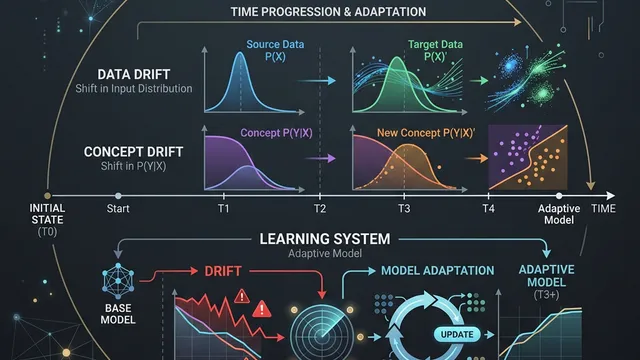
The clearest reason to want this property is a specific failure it prevents. A frozen system deployed into a slowly drifting environment degrades silently. Its accuracy falls as the world moves away from its training distribution, and nothing inside the system registers that anything has shifted, because it has no channel through which the outcomes of its predictions can reach the state that generates them. A system with runtime coupling to consequence has that channel, and the drift becomes a signal instead of an invisible decline.
The claim is falsifiable in a straightforward way. If performance on held-out static data reliably predicted performance after deployment under distribution shift, then runtime coupling would be redundant, and the snapshot would suffice. The reason to take the property seriously is that this prediction does not hold in practice.
Reframing the measurement problem
The temptation at this point is to propose a benchmark that closes the gap. That temptation is worth resisting, because the difficulty is not that the field has chosen poor test sets. The difficulty is conceptual. We are trying to measure a rate of change with an instrument built to measure a level. A better static test set is still a static test set. It reports where a system stands at one moment, and the quantity we care about is how the system behaves across many moments as its environment shifts and as its own past predictions return to it as evidence.
Evaluating continual learning well would mean treating the passage of time and the arrival of consequence as part of the measurement itself. It would mean scoring a system on how it handles the outcomes of its own predictions over an extended run, under conditions that move. This is harder to standardize than a fixed benchmark, and it resists the clean leaderboard that has organized so much recent work. That difficulty is the honest state of the problem. The task ahead has less to do with finding the right number than with deciding what it would mean to keep a system in contact with the results of what it does, and how that contact should be observed.
Frequently asked questions
What is continual learning?
Continual learning refers to a system that continues to update its internal state after deployment, using data that arrives during operation, rather than one whose state is fixed at the end of a training phase. The defining question is not how much a system knows at a single moment, but whether it can revise what it does as its environment changes.
What is runtime coupling to consequence?
It is the capacity of a system to adjust the state it uses for prediction during operation, in response to the measured error between its earlier predictions and the outcomes that followed them. The signals it consumes are realized outcomes and prediction errors. What it changes is the internal state used for the next prediction, and where the system directs its representational capacity.
Isn't this just online learning under a different name?
Online learning describes an algorithm that updates on each incoming example. The concern here is architectural rather than algorithmic. It asks what channel carries the outcomes of a system's own predictions back into the state that generates them, and whether that channel exists at all. An online update rule can be one component of such an architecture, but naming the update rule does not settle whether the loop between prediction and consequence is closed.
Isn't this just a benchmarking problem that a better test set would solve?
A richer or more adversarial static test set still measures a level at a single moment. The quantity of interest is how a system behaves across time as conditions drift and as its past predictions come back as evidence. That is a property of an extended run, and no snapshot, however well constructed, reports on it directly.
How would you test this in a real system?
Run the system against a stream in which the distribution is allowed to move over time, withhold the outcome of each prediction until the point at which the world would actually reveal it, and feed those outcomes back in the order and with the delay they would carry in deployment. Then measure how performance holds across the run rather than at its end, and compare a system that can revise its state at runtime against a frozen counterpart under identical drift. The comparison of interest is the slope of the two curves over time, not the height of either at any single point.