

Learning the Shape of a Rule It Was Never Shown
A continuous learning system recovers the shape of hidden cost rules, an exemption, a cap, a surcharge band and a progressive kink, from the consequences of its own decisions
Abstract
Our earlier reports showed a continuous learning system finding a hidden proportional tax and following it when the rate changed. A proportional rule is a straight line, and here we ask whether the system's memory can hold a rule with a shape: an exemption, a progressive kink, a cap, a surcharge band. Each was placed twice, on a boundary of the memory's gain grid and inside a level, and everything was sealed and timestamped before the runs. On three previously unopened seeds the memory reproduced every committed shape at both placements and located every landmark within the registered tolerance, including landmarks the grid cannot represent directly. A first test had failed on an instrument defect. The corrected instrument was frozen before the fresh seeds ran. A tuned Q-learning baseline on the same data did not pass the entry test: it read the proportional rule at four to six times its rate, differently in every seed. Results are internal and have not been independently replicated. No performance figures are reported.
1. The question
A system that must be told every rule inherits every omission its designers made. Our earlier reports established that this system can find a rule nobody wrote down, provided the rule is a fixed fraction of a gain. Real frictions are seldom that simple: tax schedules have thresholds and brackets, fees are capped, penalties apply within windows. A rule with a shape is harder to find from outcomes, because no single outcome reveals it. The shape exists only across many decisions at different levels of gain, and a learner that stores one number per situation has to assemble it piece by piece.
The question is a narrow one. By the shape of a rule we mean the qualitative form of the realization cost as a function of the gain at which a position is sold: a step, a kink, a ceiling, a bump. Nothing else about a rule is at issue here. Given a hidden cost rule with such a shape, does the system's stored experience come to hold it, and can a fixed test, agreed before the runs, read it back?
2. What was tested
Environment and interface. Unchanged from the previous reports, which should be read first: 267 registers, daily prices from 2000 to 2026, 6,791 decision steps per run, three buttons per register, and an outcome that is the resulting change in value net of costs. The system is told nothing about the domain. The cost rule exists only in the environment's accounting and in the outcome record, never in anything the system reads when deciding.
The five rules. Every rule is applied to the gain realized when a position is sold, after the transaction fee.
| RULE | WHAT IT CHARGES |
|---|---|
| proportional (control) | a fixed fraction of the gain |
| exemption | nothing below a threshold, then a fraction of the excess |
| progressive | a low fraction below a threshold, a higher one above it |
| cap | a fraction of the gain, never more than a ceiling |
| surcharge band | a fraction of the gain plus a triangular surcharge over a window |
A zero-cost control was run alongside. Every shaped rule was scaled to charge the same average cost as the proportional control over a fixed reference exposure, so that no rule was simply louder than another. Equalizing the average cost does not equalize identifiability, since a localized surcharge is harder to read than a proportional rule at the same average cost. It only prevents total cost from telling the rule families apart.
Two placements. The system's memory stores one value per level of unrealized gain, seven bounded levels between zero and 35% and one open level above. Each shaped rule was placed twice: with its landmark exactly on a boundary between two levels, and with its landmark inside a level. A landmark inside a level is only partly visible to a memory that averages across that level, so the second placement is the harder test.
What is read. The learned value of selling at each of the seven bounded levels, read at two levels: what the system has stored about one specific kind of situation, and the aggregate it acts on. A profile is the seven values for one rule, one placement and one seed. Every profile is read at both levels, so the thirty profiles of the second test give sixty profile-readout evaluations. The seven values are reduced to nine contrasts, six differences between neighbouring levels and three curvatures, and a contrast counts only if it exceeds a noise band measured on the control runs. None of this changed between the first test and the second.
The decoder. A fixed library of 621 candidate rules, every form on a registered grid of landmark positions, each candidate's expected seven values computed by integrating its charged cost over the reference exposure. A profile is identified as a form when its pattern of contrasts is nearer to a candidate of that form than to any candidate of any other form by at least a registered margin, and localized when the landmarks of all candidates within that margin sit within a registered tolerance of the truth: one level for a boundary placement, two for an inside placement. A group passes when at least two of three seeds identify and localize, with all three seeds required to have complete evidence. That rule was fixed in the registration before the runs. The registration records the rule without a derivation of it, and Section 3.1 reports how often the third seed was needed.
Pre-registration. As in the earlier reports, everything above was frozen in a manifest, sealed and externally timestamped before the runs, and graded on its literal wording afterwards. The three seeds used for the result in Section 3.1 had never been used in any prior study, and no profile from them was opened by anyone until the decoder had been sealed and the grader run once.
The decoder is the second one built for this study. A first, registered test on three earlier seeds failed seven of sixteen shape group tests, eight groups at two readouts. Those failures traced to the instrument: it had assigned each candidate's sign pattern with a zero threshold while observations were thresholded with the real noise band, and applying the real band to its own predicted profiles changed the pattern of every inside placement and of no boundary placement. The learner's profiles pointed the way the predictions pointed throughout, within a cosine distance of one hundredth in all twenty-four shape profiles, though not at the predictions' magnitude. The decoder above was rebuilt on those thirty profiles, which makes them a development set, and two of its settings, the gate's noise level and the overlap margin, were chosen on that data. It was then sealed, timestamped, and applied once to the three fresh seeds. Nothing in Section 3.1 comes from the development set. What the fresh seeds establish is generalization across seeds within the registered design: the same learner, environment, memory grid and rule family. They do not establish generalization beyond it.
3. Results
3.1 Rules with a shape
The memory stores one value per level of gain. A rule whose landmark sits on a boundary between two levels asks the memory only to hold different values on either side, which it can do directly. A rule whose landmark sits inside a level asks for something it cannot do directly: the level that contains the landmark receives experience from both sides of it and can store only one number. Whether that number, together with its neighbours, still carries enough of the rule to place the landmark is the question that distinguishes this study from a test of whether a learner can fit a bend. Figure 1 shows the inside placements.

The level that holds a landmark stores a value between what the rule charges on either side of it, and the levels around it hold the rest of the shape. Below an exemption threshold the values sit at the floor the zero-cost control learns. The level containing the threshold stores a little above that floor, and the levels beyond it rise with the charged line. Where a cap flattens the rule, the level containing the cap stores a value at the ceiling and every level above it stays there. The surcharge band appears as a bump of 10.7 to 10.9 percentage points in the level that holds the peak, against a charged surcharge that reaches 12.9 at the peak itself, with the rise beginning in the level that holds the band's lower edge. From those values the decoder placed every landmark of the exemption, cap and surcharge band within the registered tolerance of two levels, in every seed. For the surcharge band that is three landmarks per seed. The three seeds lie almost on top of one another. The progressive schedule placed inside a level, the registered resolution probe, was identified and localized in two seeds. In the third it was ambiguous with the proportional family, as its near-proportional ideal profile had led us to expect.
Figure 2 shows all eight placements together, boundary and inside, for the same seeds. The boundary placements are the reference case: the memory's levels line up with the rule, and the stored values follow the charged curve step by step.

| RULE | PLACEMENT | SITUATION-LEVEL READOUT | WHOLE-READOUT LEVEL |
|---|---|---|---|
| zero-cost control | 3 of 3 read as no rule | 3 of 3 | |
| proportional control | 2 of 3, one seed ambiguous with progressive | 2 of 3 | |
| exemption | boundary / inside | 3 of 3 / 3 of 3 | 3 of 3 / 3 of 3 |
| progressive | boundary | 3 of 3 | 3 of 3 |
| progressive | inside, registered probe | 2 of 3 | 2 of 3 |
| cap | boundary / inside | 3 of 3 / 3 of 3 | 3 of 3 / 3 of 3 |
| surcharge band | boundary / inside | 3 of 3 / 3 of 3 | 3 of 3 / 3 of 3 |
Table 1. Seeds identified and localized within the registered tolerance, per rule-and-placement group and readout level. Eighteen committed group tests pass. The two probe tests are reported without being graded. Evidence was complete in every one of the thirty profiles at both readouts.
Sixteen of the eighteen committed tests passed with all three seeds. The two that passed with two are the proportional control at both readouts, whose third seed was ambiguous rather than wrong.
Two rows deserve comment. The proportional control lost one seed to ambiguity with the progressive family: the nearest progressive candidate sat within two thousandths of the nearest proportional one at the situation level and within six thousandths at the whole-readout level, against a registered margin of one hundredth. A progressive rule whose two rates are nearly equal is nearly proportional, and the library cannot separate them at this resolution. The group passed under the registered rule. The progressive rule placed inside a level was registered in advance as a resolution probe for the same reason: its two rates, forced close together by the equal-average-cost rule, make its ideal profile itself ambiguous with the proportional one. It was excluded from the verdict, and it read correctly in two seeds regardless.
Every registered prediction held: the four boundary groups pass at both readouts, eight tests; the three committed inside groups, exemption, cap and surcharge band, pass at both readouts, six tests; both controls pass at both readouts, four tests; and the falsifier, two or more inside placements failing, is empty.
3.2 A standard learner on the same data
Would any learner read these shapes off this data? To find out we ran the baseline used in the rule-change report, tabular Q-learning on the same situation representation with counterfactual crediting, the same crediting our system uses, under the same protocol: the two control rules at the same three fresh seeds, sealed and timestamped before the runs, no profile opened until all six had finished.
The protocol has an entry test. Before a learner's shaped rules are graded, its own controls must pass: the zero-cost control must read as no rule, and the proportional control must read as proportional, judged against a noise band derived from those same six control profiles by the registered method. The band serves two purposes by design. It measures how unstable the learner is across seeds, and it sets the threshold a profile must clear to count as carrying a rule. A learner whose proportional profile varies more between seeds than it rises across gain has not stored the rule in a form that can be read back. The entry test therefore measures whether the representation is stable and quantitatively identifiable, which is a different question from whether the learner has learned anything. Our system passed that test in the first report, which is what licensed everything in Section 3.1.

The baseline fails the entry test. Its zero-cost profiles wobble by up to 0.4 percentage points between neighbouring levels, twenty times the 0.02 of ours on the same seeds. Its proportional profiles rise in the right direction, but at a slope of 1.03, 1.05 and 1.39 percentage points per point of gain where the rule charges 0.25, and ours reads 0.252, 0.253 and 0.258. They are negative at the two lowest levels in every seed and differ from one another by several percentage points. The noise band the registered method derives from this variation is 12.8 percentage points at the situation level, forty-six times ours, and wider than most of the baseline's own signal: two of the three proportional profiles fall entirely inside it and read as no rule. One of six readings correct against a required four. Because the baseline failed the registered entry criterion, its shaped rules were not run. Under this protocol their readout would not have been interpretable.
| ZERO-COST CONTROL | PROPORTIONAL CONTROL | SLOPE READ, POINTS PER POINT OF GAIN (RULE: 0.25) | |
|---|---|---|---|
| our system, own band | 6 of 6 read as no rule | 4 of 6 read as proportional, 2 ambiguous with progressive | 0.252 / 0.253 / 0.258 |
| baseline, own band | 6 of 6 | 2 of 6, the other four read as no rule | 1.03 / 1.05 / 1.39 |
| baseline, our band and library | 4 of 6, one seed reads as surcharge band | 6 of 6 |
Table 2. Control readings at both readout levels, three seeds each. The last row is descriptive: the baseline judged by the instrument built for our system.
How this squares with the earlier report. The rule-change study credited the baseline with detecting rule changes under its registered criterion. That study scored each run against its own anchors, so a run whose 25% level was several times another's still counted as detecting its own change. The report noted in passing that the baseline's 25% anchor was a lottery across seeds and that its null-rule reading was as large as our true signal. This study asks what the rule is, and a shape can only be read if it is the same from seed to seed. The seed-to-seed variation that was a footnote in the earlier report therefore becomes the decisive quantity here. The baseline learns a policy-relevant signal, that selling at higher gain costs more, and it acts on it. What it does not maintain is a quantitatively faithful representation of the rule. Its scale is four to six times the charged rate and differs by a third between seeds. This report is about that difference: a signal that is good enough to act on, and a representation that is good enough to read.
Two caveats. First, the last row of Table 2 shows that the baseline's proportional profiles point the right way: judged by our instrument, all six read as proportional. It fails on scale and stability rather than on direction. Under a band derived from its zero-cost controls alone, ignoring the instability of its proportional runs, its entry test passes. That would be a choice made after the read, which the protocol forbids, and it is recorded as such. Second, this is one tabular learner in one configuration, chosen because it is the baseline of our earlier reports and the more favourable of its two crediting variants. The experiment does not test whether other Q-learning configurations, or other learners, could recover the shapes. A model trained on the realized costs would read the schedule trivially. The claim is narrower: given the same experience and asked to act, our system's memory comes to hold the rule at its true scale, the same way every time, and this configuration of a standard learner's does not.
4. Limitations
Finite grid. Landmarks are localized to an interval on a registered grid of thirteen positions rather than to a point. The tolerance is one level for a boundary placement and two for an inside placement. Every hull in Section 3.1 met it, and none pins a landmark more finely than that.
Calibration is descriptive. Nothing in the graded result converts learned values into charged cost. Figures 1 and 2 plot both on one axis without rescaling and the reader can judge the agreement, but the instrument decides on shape alone.
The near-proportional edge of the progressive family. A progressive rule with nearly equal rates is nearly proportional, and the library is registered as unable to separate the two. This cost one seed of the proportional control and made the inside progressive placement a probe. This is a resolution limit of the instrument at this margin rather than a finding about the learner.
One learner, one grid, three seeds. The memory's seven bounded levels were fixed before the study. Whether a finer or coarser grid would resolve inside placements more or less easily was not tested.
Recognition within a library. The verdict comes from a library of candidate rules. The study shows that the memory's profiles are recognized as the right member of a registered family. It does not show what the profile would reveal about a rule of a form the library does not contain, which is the obvious next test and has not been run.
Replication. All results are internal. Every manifest, verdict and receipt is retained and hash-pinned, and none has been independently replicated.
5. Conclusions
A memory that stores nothing but numbers ends up holding the shape of a rule it was never shown. Given an exemption, a kink, a cap or a band, the stored value of selling bends where the rule bends, at both placements, on seeds no one had looked at, as read by a test fixed before those seeds ran. The first end-to-end test failed because the registered readout thresholded its own predictions inconsistently with the observations, while the learner's profiles pointed where those predictions pointed. That the rebuilt instrument passed on the profiles it was built from proves nothing. That it passed on thirty previously unopened profiles from the registered design, as its sealed predictions said it would, is the evidence. A standard learner in the configuration we tested holds the direction of the simplest rule but neither its scale nor a stable shape. Under this protocol it never reaches the question this report asks, and whether another configuration would is untested.
All results were produced internally by Wakeline GmbH and have not been independently verified. Figures are approximate and rounded. This report describes a research system evaluated on historical market data in a simulated environment. It does not describe a live trading system, and no capital was deployed. Simulated results are hypothetical, carry inherent limitations, and are not indicative of any future outcome. Nothing in this report is investment advice, an investment recommendation, an investment strategy recommendation, or a financial analysis, and nothing here constitutes an offer or invitation to buy, sell or subscribe to any financial instrument. No statement is a claim about trading performance, and no performance figures are published. Wakeline GmbH does not provide investment advice, investment brokerage, portfolio management or any other financial service requiring authorisation, and is not supervised by BaFin in any such capacity.
Appendix. Pre-registered predictions, graded
| # | EXPECTATION AS WRITTEN | VERDICT |
|---|---|---|
| A | First test, first decoder: all sixteen shape group tests pass | Failed as registered: 9 of 16, all seven failures at inside placements; the instrument's zero-threshold sign patterns disagreed with its own real-band patterns at every inside placement and no boundary placement |
| 1 | Second test: the four boundary groups pass at both readouts, eight tests | Confirmed; 24 of 24 profile-readout evaluations identified and localized |
| 2 | Exemption, cap and surcharge band pass inside at both readouts, six tests | Confirmed; 18 of 18 profile-readout evaluations identified and localized |
| 3 | Progressive inside is a resolution probe, no committed outcome | Reported: identified in 2 of 3 seeds; the third ambiguous with proportional at both readouts |
| 4 | Both controls read correctly in all six profiles at both readouts | Confirmed for the zero-cost control 6 of 6; proportional 4 of 6, one seed ambiguous with progressive at both readouts, group passed under the two-of-three rule |
| F | Falsifier: two or more of the inside exemption, cap, surcharge placements fail | Not met; none failed |
| B | Baseline entry test: both controls read correctly at both readouts under the baseline's own band before any shaped rule is run | Failed: zero-cost 6 of 6, proportional 2 of 6; shaped rules not run |
Accounting. A group is one rule at one placement. Each group is graded at both readout levels, three seeds per test, and a test passes when at least two seeds identify and localize.
| CATEGORY | GROUPS | TESTS (× 2 READOUTS) | RESULT |
|---|---|---|---|
| controls (zero-cost, proportional) | 2 | 4 | 4 pass |
| committed shape tests (exemption, cap, surcharge band at both placements; progressive at the boundary) | 7 | 14 | 14 pass |
| resolution probe (progressive inside) | 1 | 2 | reported, 2 of 3 seeds each; not graded |
| total | 10 | 20 |
The seven committed shape groups are exemption, cap and surcharge band at the boundary and inside placements, and the progressive schedule at the boundary. A group test passes when at least two of its three seeds identify and localize. At seed level the committed tests comprise 54 profile-readout evaluations, of which 52 identified and localized. The other two, the proportional control's third seed at both readouts, were ambiguous with the progressive family. The probe's six evaluations: four identified and localized, two ambiguous with the proportional family.
Manifests, the candidate library, gate reports, both verdicts including the first test's, the baseline's sealed registrations and one-time read, and timestamp receipts are available on request.
Related articles
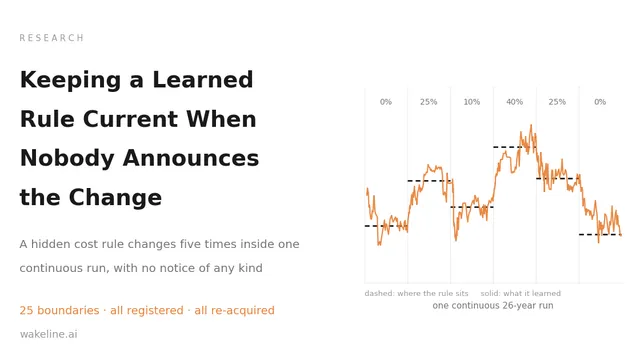
Keeping a Learned Rule Current When Nobody Announces the Change
A continuous learning system re-derives a hidden cost structure five times as it changes, keeping its learned understanding current without being told when the changes happen or what the new rules are.
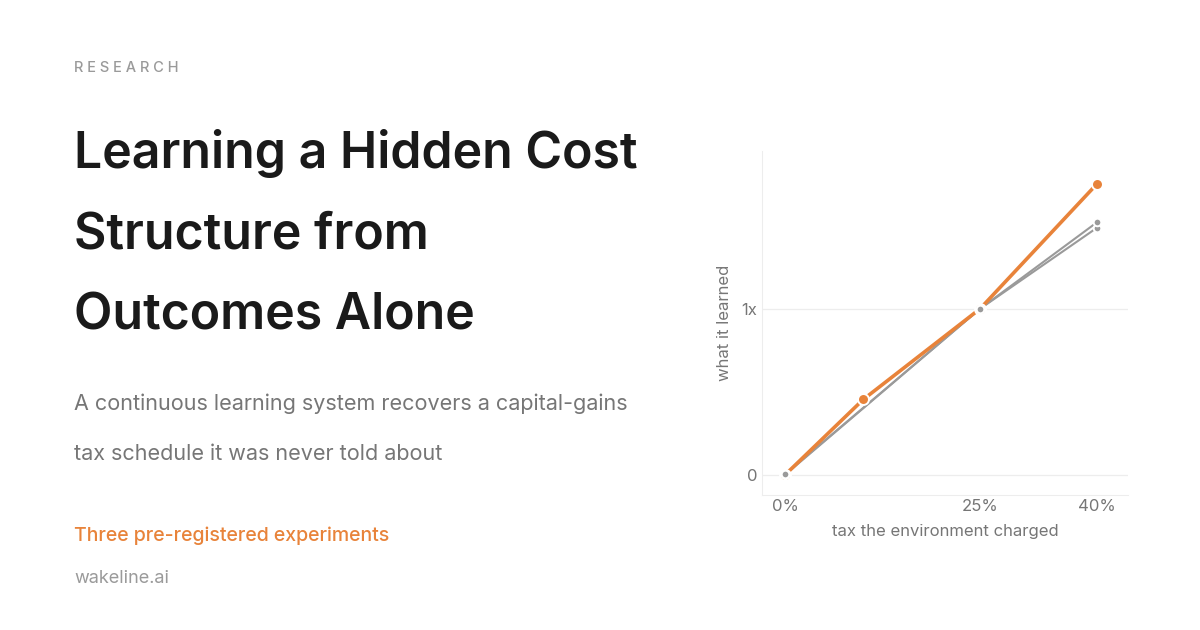
Learning a Hidden Cost Structure from Outcomes Alone
Across a 26-year simulation, a continuous learning system recovers a hidden 25% capital-gains tax schedule from outcomes alone, calibrated to within about 6% at every bounded level of gain.
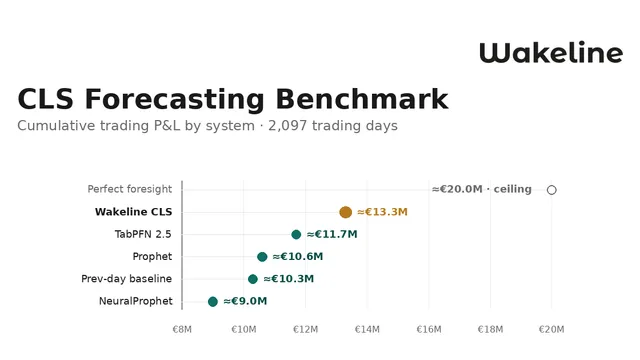
The CLS Forecasting Benchmark: Continual Learning Measured in Euros
The CLS forecasting function delivers approximately 14% higher cumulative trading P&L than TabPFN over 2,097 trading days on the German-Luxembourg day-ahead market. We present the benchmark results, methodology and limitations.

Investment Opportunities
We are currently engaging with investors and strategic partners interested in long-term technological impact grounded in scientific discipline.
Wakeline represents a fundamentally different approach to artificial intelligence, prioritizing continuous adaptation, reduced compute dependence, and real industrial application.
Conversations focus on collaboration, evidence building, and shared ambition.